A simple framework behind the world’s most powerful monopoly
When people hear the name John D. Rockefeller, they usually think of oil, money, or monopoly.
But Rockefeller’s real innovation wasn’t oil.
It was structure.
He didn’t just build a big company.
He designed a system where competitors couldn’t survive, even if they worked harder or smarter.
This article breaks down:
- The 3 structures he used
- The framework behind them
- And the exact stages he controlled, in simple language

The Rockefeller Framework (Big Picture)
Before diving into details, understand this simple idea:
Rockefeller didn’t compete at one level of business.
He controlled every level of the business stack.
Most businesses fight on:
- Product
- Price
- Marketing
Rockefeller fought on:
- Ownership
- Infrastructure
- Legal structure
- Cost control
That’s why competitors didn’t lose battles.
They lost the ability to fight.
Structure 1: Trusts — Centralised Control Without Visible Ownership
What problem existed?
In the 1800s:
- Companies could not easily own other companies across states
- Rockefeller owned dozens of oil-related businesses
- Managing them separately limited power and speed
What Rockefeller created
He pioneered the trust structure.
In a trust:
- Multiple companies hand over their shares to a small group of trustees
- Trustees make decisions for all companies
- Original owners still earn profits, but control is centralized
Why this mattered
- On paper, companies looked independent
- In reality, one group controlled them all
- Regulators couldn’t easily prove monopoly behavior
This was the first large-scale example of control without direct ownership.
Structure 2: Holding Companies — Making Control Legal and Scalable
Why trusts weren’t enough
As public pressure increased, trusts became controversial.
Rockefeller adapted.
The upgrade: holding company
A holding company:
- Owns controlling shares in multiple businesses
- Does not run daily operations
- Controls strategy, leadership, and capital allocation
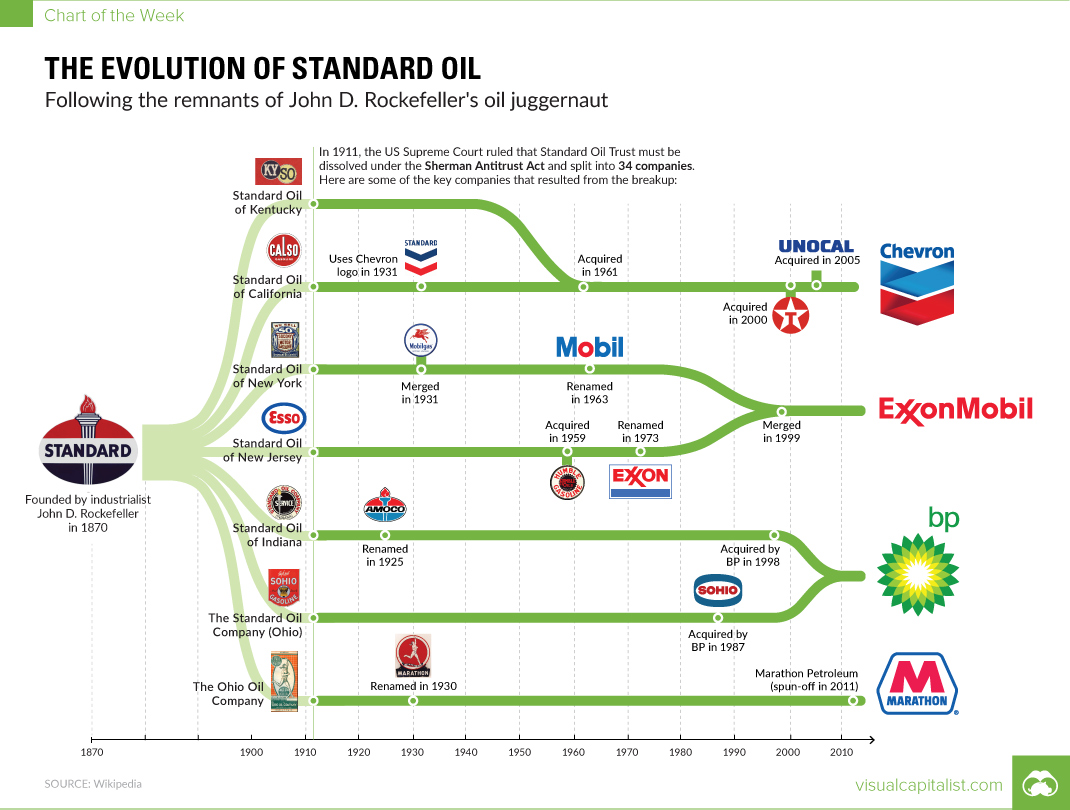
Standard Oil of New Jersey became the parent company controlling dozens of subsidiaries.
Why this was powerful
- Central decision-making
- Legal recognition
- Easy expansion into new regions
- Easy restructuring when laws changed
This model is still used by:
- Conglomerates
- Multinational corporations
- Large technology companies
Structure 3: Vertical Integration — Owning the Entire Value Chain
This is where Rockefeller truly eliminated competition.
Instead of doing one part of the oil business, he owned every step.
Below is the framework, explained stage by stage.
The Vertical Integration Framework (Stage-by-Stage)
Stage 1: Extraction — Oil Wells
Rockefeller either owned oil wells directly or controlled long-term supply contracts.
Why this mattered:
- Guaranteed access to raw material
- Protection from supply shortages
- Ability to plan long-term production
Competitors often depended on third parties for oil. Rockefeller did not.
Stage 2: Transport — Rail Contracts and Pipelines
Transport was the most expensive and risky part of the oil business.
Rockefeller:
- Negotiated exclusive rail contracts
- Secured lower shipping rates
- Later invested in pipelines
Why this mattered:
- His transportation cost was lower than everyone else’s
- Competitors paid more to move the same oil
- Railroads prioritized his shipments over others
Control of transport meant control of survival.
Stage 3: Refining — Massive Refineries
Rockefeller invested heavily in large, efficient refineries.
Why this mattered:
- Lower per-unit cost
- Higher output
- Better quality and safety standards
Smaller refiners couldn’t match his scale.
Even if they had customers, they couldn’t match his margins.
Stage 4: Packaging — Barrels and Cans
Instead of buying packaging, Rockefeller owned:
- Barrel factories
- Tin and can suppliers
Why this mattered:
- Reduced dependency on suppliers
- Lower packaging costs
- Faster operations
Competitors paid market prices.
Rockefeller paid internal costs.
Stage 5: Distribution — Warehouses and Retailers
He controlled:
- Storage facilities
- Regional warehouses
- Distribution networks
Why this mattered:
- Faster delivery
- Reliable supply
- Strong relationships with retailers
Retailers preferred dealing with Standard Oil because it was stable and predictable.
Stage 6: Pricing — Market-Wide Influence
Because his costs were lower at every stage, Rockefeller could:
- Temporarily lower prices
- Absorb losses competitors couldn’t
- Acquire struggling businesses cheaply
Once competitors exited or sold, prices normalized.
This wasn’t random pricing.
It was structural pricing power.
Why This Framework Crushed Competition
Rockefeller didn’t win by:
- Advertising more
- Innovating faster
- Hiring better salespeople
He won because:
- His costs were lower by design
- His risks were controlled by ownership
- His competitors depended on systems he controlled
They were not inefficient.
They were structurally disadvantaged.
Final Takeaway
Rockefeller’s genius wasn’t oil, money, or aggression.
It was this insight:
If you control the structure of an industry,
you don’t need to fight competitors.
The system defeats them for you.
That single idea still shapes how the biggest companies in the world operate today.
 Buzzpathy
Leave a comment